How the ranks work
Why each area I work in has a letter from E to S, what the letters and the materials mean, and where I stand today.
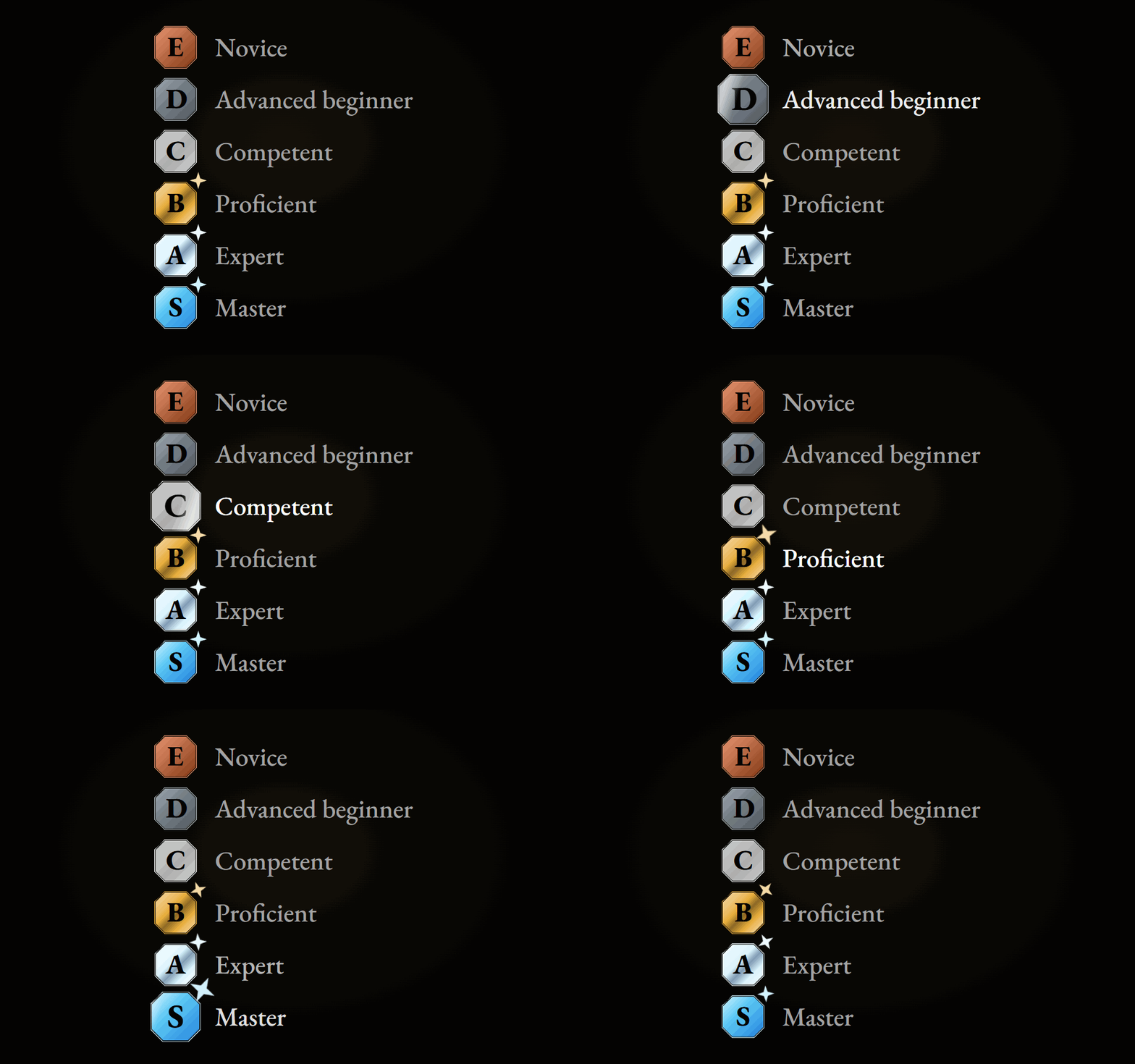
On the home page, each area I work in carries a small badge: a letter and a material. This page explains what they mean, so the home page can stay clean.
Why ranks, and why by area
Every field has endless skills. A list of tools would never be complete, and a bar for each one would say little. So I rank the area as a whole: how deeply I can work in software engineering or in writing.
The rank is my own assessment, not a certificate. I would rather show a low letter that is true than a high one that is not, and I will change it when it stops being true.
The scale I follow
Two ideas are mixed here, each for a different job:
- The letters, E to S, follow a convention that is common in games: E is the lowest rank and S the highest, with S above A. That S comes from Japanese school grading.
- The meaning of each step comes from the Dreyfus model of skill acquisition (Hubert and Stuart Dreyfus, 1980): novice, advanced beginner, competent, proficient and expert, with mastery above them. It describes how a person works at each stage, and it applies to any field.
| Rank | Name | Material | What it means |
|---|---|---|---|
| E | Novice | Copper | Follows rules and examples step by step. Needs help to know what matters. |
| D | Advanced beginner | Iron | Recognizes common situations and solves small tasks alone, but still leans on rules and guides. |
| C | Competent | Silver | Plans, sets priorities and answers for the result. Can finish a whole piece of work alone. |
| B | Proficient | Gold | Sees the situation as a whole, picks the right approach quickly and spots problems early. |
| A | Expert | Platinum | Works fluidly from experience, solves unusual problems and can teach others. |
| S | Master | Diamond | Shapes the craft itself: new methods that others learn from. |
The materials
I chose materials for the ranks following the logic of games: each tier is named after a material, and the materials get nobler as the rank goes up. Here the ladder is copper, iron, silver, gold, platinum and finally a blue diamond.
How a rank changes
A rank goes up when I can meet the criteria of the next step on real work, alone, and not only in exercises. Until then it stays where it is, even if I am studying the next level.
Tools and skills
The tools and skills used in the process appear at the bottom of each project page as # tags. Clicking a tag opens a list of projects that use them.

References
- Hubert L. Dreyfus and Stuart E. Dreyfus, 1980. Summary: Dreyfus model of skill acquisition (Wikipedia). The names and the meaning of the steps.
- S Rank (Console Games Wiki). On the S above A, which comes from Japanese school grading; the page itself says the exact origin is not documented.